
Rules & Regulations
Madison Recreational Soccer rules and guidance. Season updates will be posted when registration opens.
These are the existing recreation guidelines. Any rule updates for Spring 2027 will be posted when registration opens, along with age groups by birth year.
Divisions & game length
| Division | Game time | Players on field |
|---|---|---|
| 100s | 4 × 6-minute quarters | 5 + 1 goalie |
| 200s | 4 × 8-minute quarters | 6 + 1 goalie |
| 300s | 4 × 8-minute quarters | 6 + 1 goalie |
| 400s | 2 × 20-minute halves | 8 + 1 goalie |
| 500s | 2 × 25-minute halves | 10 + 1 goalie |
If teams are short-handed or have extra players, both coaches can agree to play with more or fewer players.
Recommended positions
These positions are recommended, not required. The options below are reproduced as published.
- 100s: 2 offense, 3 defenders.
- 200s and 300s: 2 offense, 2 midfielders, 2 defenders; or 1 offense, 1 midfielder, 3 defenders.
- 400s: 2 offense, 3 midfielders, 3 defenders; or 2 strikers, 2 midfielders, 3 defenders, 1 sweeper.
- 500s: 3 offense, 3 midfielders, 3 defenders, 1 sweeper; or 1 striker, 2 offense, 2 wings, 1 center mid, 1 center back, 3 defenders.
If your team has a five-goal lead, switch to a more defensive position and focus on foot skills, proper passing, and dribbling techniques.
Equipment
- One coach provides the game ball to the referee.
- All players in the 200s–500s must wear shin guards and soccer cleats.
- Metal cleats and football or baseball cleats are not allowed.
- All players should have a drink with them on the bench.
The recreation FAQ also requires shin guards for games and makes cleats optional for Early Learners and the 100s.
Before play & weather
Only players and registered coaches are allowed near the children’s benches on game days. All registered personnel must have a background check on file with Madison Soccer League. Do not sit near the goalie or goal side; this can be dangerous and distracting.
Games are not canceled for light rain. The published rules specify a 20-minute postponement for thunder or lightning, and that a game concludes if thunder or lightning occurs in the second half. On days with inclement weather, check with your coach for updates.
Coaches may cancel games for inclement weather and should notify the Rec President so both teams can be informed. Coaches organize rescheduled games, generally on a weeknight.
Gameplay
Where coaches may assist
- 100s: Two coaches may assist on the field or goal side.
- 200s: One coach may assist on the field or goal side.
- 300s: One coach may assist on the field for the first week as a refresher. After week one, coach only from the sidelines or goal side of your half of the field.
- 400s and 500s: Coach only from the sidelines or goal side of your half of the field.
Coaches must remain appropriate and demonstrate good sportsmanship. The first team on the schedule gets the ball first.
Kickoff and restart after a goal
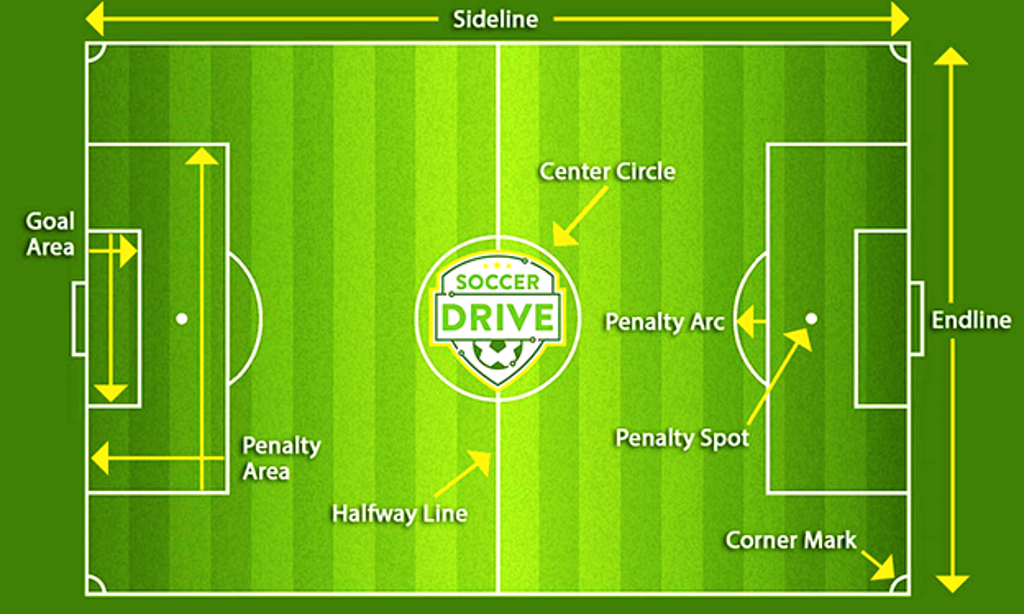
The ball is placed at the center point. Each team stands in its own half outside the center circle, with one or two starting-team players inside the circle. On the whistle, a starting player passes the ball to their team. Play is live as soon as the ball is kicked, and the other team may advance. The starting player cannot kick the ball again until another player from either team touches it.
Third-goal rule
A player who scores three goals must play midfield or defense for the rest of the game. The exception is a tie in the fourth quarter or second half: that player may play offense if a game-saving goal is needed.
Slide tackles and headers
Slide tackling and intentional heading are not allowed in any Madison Rec age group. A foul may be called and an indirect kick awarded.
A player who accidentally uses their head must leave the field for concussion review before returning. All coaches will have taken a concussion protocol course and should report any hit to the head or neck to MSL officials.
Throw-ins & restarts
Throw-ins
When the ball exits over a sideline, the team that did not send it out takes the throw-in. Both feet must be on the ground when the ball is released. A dragging foot is allowed if it remains on the ground through release. No hopping. The ball must pass over the player’s head, not one-handed or to the side.
- 100s: Retry with assistance as much as necessary.
- 200s: Two retries with assistance.
- 300s: One retry.
- 400s and 500s: No retries.
A goal cannot be scored directly from a throw-in. A player on the field must get the ball into the goal.
Direct and indirect kicks
Contact fouls and handballs generally result in an indirect kick. Direct kicks are not allowed in any Madison Soccer age group. For an indirect kick, the player taking the kick must pass to a teammate before the ball can be played to score from the violation spot.
Corner kick or goal kick?
When the ball crosses a goal line, a defending-team touch results in a corner kick; an attacking-team touch results in a goal kick.
Corner kicks
Take the kick from the corner arc on the side where the ball exited. The selected player waits for the whistle, then kicks toward teammates. The kicker may not touch the ball again until another player touches it.
Goal kicks
The following instructions preserve the original page, including its differing instructions about passes inside the penalty box. Ask the Rec President which instruction applies.
- Goal kicks are taken from the edge of the goal area / six-yard box. The goalie may place the ball on the goal-area line and kick outside the penalty box; a chosen kicker may also take the kick.
- The published page also says the goalie may pass to a player within the box and the ball does not have to be kicked out of the penalty box.
- It further asks opposing players to back up and not touch the ball until it exits the penalty box. A kick that does not leave the box, or another player touching it before it leaves, is described as a redo.
Opposing teams wait behind the halfway line for the 100s and 200s, behind the buildout line for the 300s and 400s, and outside the penalty box for the 500s.
Once the ball is put into play, the opposing team may advance. If a goalie rolls, tosses, or kicks the ball into play before opponents have time to retreat to the required line or outside the penalty box, the ball is live and playable by anyone.
Drop kicks
500s goalies may drop-kick the ball from inside the penalty area after gathering a shot. All other age groups may only throw the ball into play.
Goalkeepers
Goalies may use their hands only inside the penalty area. Using hands outside it results in an indirect kick. If the goalie controls the ball, an opponent may not kick it out of their hands.
Pass-back rule
A goalie may not use their hands when a teammate passes the ball backward to them. The goalie must control and pass with their feet. The published consequence for using hands is an indirect free kick or a throw-in, depending on the players’ age and field size.
Penalties
Handball
Deliberate use of a hand, arm, or shoulder to move the ball and gain an advantage is a handball, except when the goalie legally handles the ball. The published rules distinguish hand-to-ball from ball-to-hand: a ball merely hitting the hand, arm, or shoulder is not a handball. The referee makes the judgment based on their view; do not contest these calls.
Handballs result in an indirect kick. A handball or penalty inside the box results in an indirect kick outside the box.
Fouls
Normal bumping, shoulder-to-shoulder contact, and body contact are not fouls. A player tripping during a tackle or falling in normal play is not automatically a foul. A raised elbow or hand, or an obvious move at another player instead of the ball, generally results in a foul.
Specific fouls include shoving, charging, striking, grabbing, shirt pulling, spitting, and kicking. Fouls usually result in an indirect kick. Calls vary by age group and remain at the referee’s discretion.
Cards
- Yellow: Warning. Two yellows equal a red.
- Red: Ejection for the rest of the game for extremely unsafe or unsportsmanlike play. The team plays down a player. An MSL representative will speak with the player and guardians about the incident.
Offside
Offside is enforced in the 300s, 400s, and 500s. A player cannot be nearer the opponent’s goal line than both the ball and the second-last opponent. The position is judged when the ball is passed, not when it is received. A player who is onside when the pass is made can run ahead to receive it. There is no offside on a throw-in.
Offside is difficult to call. Do not dispute a referee’s call; report frequent problems to an MSL official, who can arrange additional referee training.
Cherry picking
In the 100s and 200s, an attacking player should not be closer to the goal than the opposing defender when receiving a pass. Cherry picking is discouraged and may result in an indirect kick for the other team from the place the ball was passed.
Referees & sportsmanship
Critical behavior toward referees by any child, coach, or parent is not tolerated. Our referees are kids and will not always make perfect calls. Direct criticism or concerns to a league representative for proper handling. Failure to respect referees may result in dismissal from the fields.
Players, coaches, and parents must remain respectful of all other players and coaches. If a player is injured, players are asked to take a knee until the injury is resolved.
Equal opportunity to play
All players should receive similar playing time regardless of gender, age, or skill. This is a for-fun league. Skilled players should not dominate playing time, and stacking a rotation to give extra time to skilled players is not tolerated, regardless of score.
End every game with respect
Coaches may choose a handshake line, fist bumps, or a wave. Both teams are expected to acknowledge the good game in some form after every match.